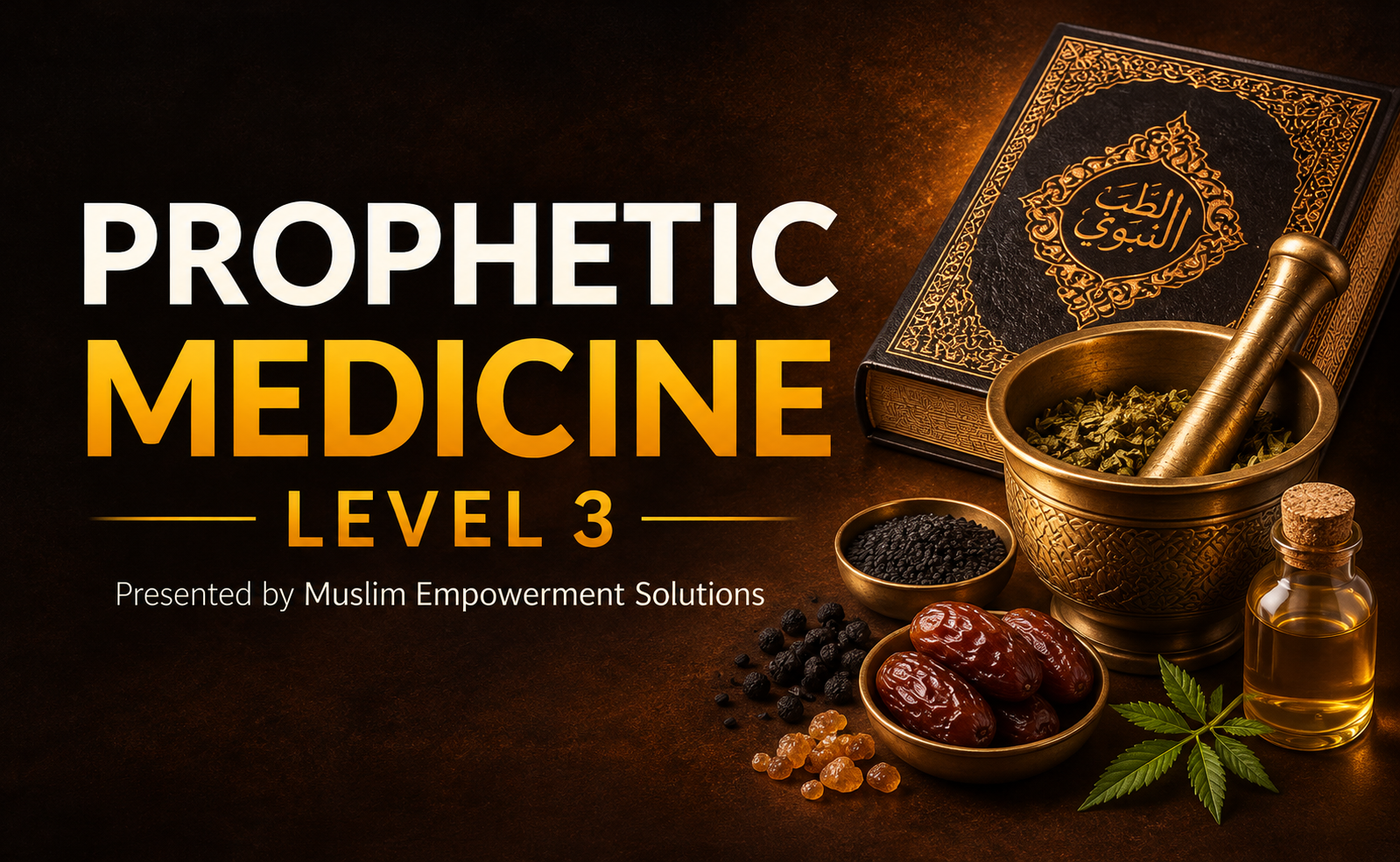
Prophetic Medicine Level 3 – Covering Islamic Medicine
£ 25.00
Continue your study of Islamic and traditional Muslim medicine with Level 3, a four-session course exploring foods, herbs, traditional preparations, common health concerns and some of the lesser-known remedies found within Islamic medical literature.
This level goes beyond simply listing remedies. Students will learn how to distinguish between authentic Prophetic guidance, reports of varying strength, traditional Muslim medical practice and general historical medicine.
This distinction is especially important. Not everything found in books written by Muslim physicians is necessarily Prophetic Medicine, and not every remedy historically used by Muslims should be attributed to the Prophet ﷺ.
Throughout the course, we will therefore look carefully at where particular remedies and practices come from, how they were traditionally understood, and how they may be considered alongside modern knowledge and appropriate safety precautions.
The aim is to develop a more informed and balanced understanding of Islamic medicine — appreciating the rich medical heritage of Muslim scholarship without exaggerating claims or attributing things to the Sunnah without evidence.
This session explores a selection of foods, plants and natural substances that appear within Islamic sources, traditional Muslim medicine and historical medical writings.
Topics include:
By the end of this session, students should be able to:
Constipation is a common health complaint and has been addressed through diet, lifestyle and herbal medicine for centuries.
In this session, students will examine traditional approaches to bowel health alongside modern understanding.
Particular attention will be given to senna, which has a recognised place within traditional medicine and is also used within modern healthcare.
We will explore how constipation can be approached holistically rather than simply treating symptoms.
Students will learn to:
Traditional medicine involves much more than simply taking dried herbs.
Different plants and substances have historically been prepared in different ways depending upon the remedy and intended use.
This session introduces students to common traditional forms of medicine and the principles behind their preparation.
We will explore:
We will also discuss why students should consider the ingredients used within modern and traditional preparations, particularly where alcohol, animal-derived ingredients or other questionable substances may be present.
Students will learn to:
The final session explores some of the more unusual practices and remedies recorded within Islamic and historical medical literature.
Rather than automatically accepting or rejecting unusual remedies, students will learn how to investigate them carefully.
We will consider questions such as:
This session also brings the course back to one of the most important principles in Islamic approaches to health: tawakkul.
Islam encourages us to take permissible means for treatment while understanding that medicine itself does not independently create healing. Healing ultimately comes from Allah.
Students will learn to:
Level 3 encourages students to move beyond simply asking:
“Is this an Islamic remedy?”
Instead, students begin asking:
Where did this information come from?
Is it authentically attributed to the Prophet ﷺ?
Is it traditional Muslim medicine rather than Prophetic Medicine?
What was the remedy traditionally used for?
What does modern knowledge tell us?
Are there safety considerations?
This allows students to appreciate the contribution of Muslim medical tradition while maintaining accuracy when speaking about the Sunnah.
This course is suitable for sisters interested in:
It is particularly suitable for students who have completed Islamic Medicine Levels 1 and 2 and wish to continue developing their knowledge.
Students who complete Levels 1, 2 and 3 complete the full Islamic Medicine Diploma pathway.
This course is educational in nature. Traditional remedies and historical medical practices should not be used as a substitute for appropriate medical diagnosis or treatment.
The course also takes care to distinguish between what is authentically established from the Qur’an and Sunnah and what belongs to later Islamic or traditional medical practice.
Studying Islamic medicine should increase both our knowledge and our humility: we take beneficial means, avoid making claims without evidence, and recognise that ash-Shāfī — the One who ultimately grants healing — is Allah.